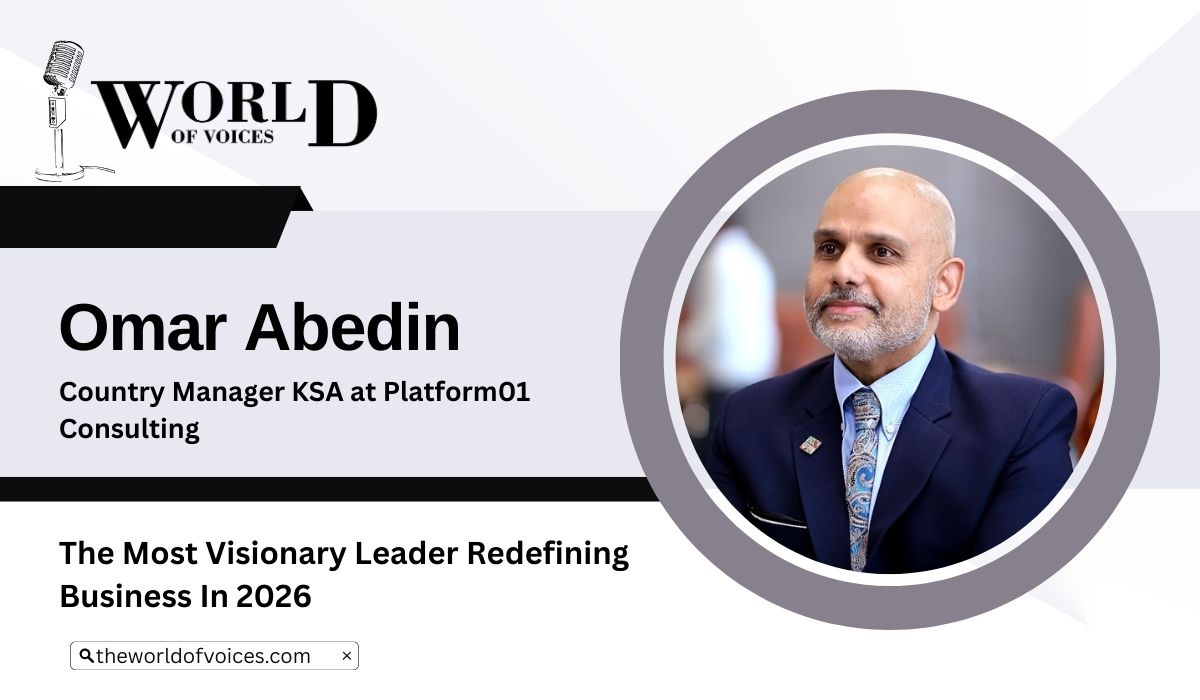
The principle “Clarity beats certainty” has helped Omar Abedin to guide his leadership activities, which stretch over more than 30 years across North America, the Middle East, and South Asia. Abedin developed his strategic development framework, which emphasizes directional clarity, through his work at Philips (Consumer Electronics), Reckitt Benckiser (FMCG), Johnson & Johnson (Personal Care / FMCG), and Novartis (OTC Pharmaceuticals) and his work at Al Etihad Credit Bureau (Fintech), London Dairy (Frozen Food / Dairy), Careem (Technology), and Graana (Real Estate).
As Country Manager for Platform01 Consulting Arabia in Riyadh, KSA, he provides advisory services to CEOs and boards through 70+ successful project implementations, which the team has completed in the past 18 months. Abedin also functions as an author, educator, and startup mentor who applies his operational discipline and strategic expertise to tackle all problems. The 3rd edition of the book “Building Brand YOU – Personal Branding in the Age of AI” serves as his latest work, which presents his belief that people build long-term authority through their continuous selection of truth instead of comfort, which has become his main career theme.
The Defining Moment: When Strategy Confronted Reality
Omar Abedin developed his leadership skills through experiences that very few strategic planners will ever encounter. The period from 2005 to 2006 served as his most important professional moment during his time at Novartis North America. The Triaminic franchise, which generated $100 million in revenue, faced an existential threat when the US FDA imposed a ban on pseudoephedrine, which served as the main active component of its primary product. The organization should have fought against the new regulation while searching for any regulatory loopholes that would have allowed them to keep their traditional operations.
Abedin, together with his team, chose to eliminate PSE from all their products instead of maintaining their existing product line because they wanted to safeguard their brand value through this temporary process. “That moment shaped how I think about leadership,” Abedin reflects. “The strategy needs to deal with actual conditions from the beginning instead of automatic protection of existing methods that have been established.” The experience taught him that decision-making requires a battle between two opposing interests, which leads to better results than choosing between immediate fulfillment and enduring power. True strategic leadership involves making difficult decisions that others overlook or refuse to make.
From Operator to Advisor: The Power of High-Quality Decisions
The three decades of Omar Abedin’s professional experience as an operator across multiple continents created a natural path toward his current work as a strategic advisor. Abedin made his professional choice because he understood that operational roles demonstrate to workers that most business issues need to be solved through directional methods rather than functional approaches. Abedin discovered through his work in three different areas that successful outcomes depended on making great decisions, which only required two particular choices.
He observed that most organizations become overwhelmed by their operational tasks because they fail to recognize the essential decisions that shape their future path. Through his strategic advisory work, he helps leadership teams establish a strategic decision-making process that combines their operational needs with the establishment of forward-looking business objectives. Platform01 has achieved exceptional success because the company has completed over 70 projects throughout Saudi Arabia and the broader GCC during the last year and a half. For Abedin, the shift from operator to advisor wasn’t about leaving the action behind; it was about multiplying his impact by helping others make the decisions that matter most.
Saudi Arabia’s Structural Reset: A CEO’s Perspective
What makes Saudi Arabia’s current transformation uniquely compelling from a leadership perspective? According to Omar Abedin, it happens because two main elements, which usually operate separately, now work together as one force. “Regulation, capital, talent, and ambition are moving in the same direction, which is rare,” he observes. The new structural system provides organizations with their most significant chance to succeed, but it also creates major dangers when executives try to implement changes without first establishing their strategic direction.
Abedin identifies the Saudi Industrial Development Fund (SIDF) as an institution that supports the Kingdom’s fast industrial development by providing essential loans to various businesses. He explains that people need to learn how to deal with such institutions because this ability represents “a hard-to-find and even harder-won skill set.” The current business situation forces CEOs to decide whether their companies can successfully handle upcoming changes or not. Abedin’s work at Platform01 focuses on helping leaders navigate this new terrain with clarity and precision, ensuring that ambition is matched by organizational capability and strategic discipline.
The Platform01 Approach: Clarity, Not Complexity
The consulting business of Platform01, which Omar Abedin operates in KSA, follows the straightforward philosophy that all work exists to create better decision-making processes that deliver measurable business outcomes. The principle governs all business operations, which include both growth strategy and turnaround and restructuring work. The process starts with a detailed examination that uses primary and secondary data to identify all client problems instead of testing existing beliefs. Abedin, together with his team, develops operational plans that executives can implement because they include specific financial details and upcoming organizational changes.
The team accomplished an entire industrial feasibility study, which included commercial aspects, technical components, and financial elements, within one week, and completed it early without reducing the study’s quality. Abedin’s operational background shows through his ability to quickly complete tasks while maintaining strict quality standards, which he demonstrated when he protected a $100M healthcare brand from regulatory dangers and shifted business growth to achieve better capital returns instead of following revenue growth trends. Abedin believes that strategy requires different approaches because it exists to simplify complex systems.
The Focus Challenge: Navigating Opportunity and Pressure
The Saudi market presents Omar Abedin with a paradox, which he describes as “The primary challenge is not speed, but focus.” Saudi Arabia provides its market participants with capital access that exceeds all other markets except for those who provide their funding under strict requirements that mandate them to develop strategic plans. Leaders face three distinct challenges, which include receiving different counsel while facing high-stress situations and encountering major chances. Family-operated enterprises experience this challenge especially because their business operations face declining success due to stronger market competition and rapid industry transformation.
Abedin warns that “What got you here is just not going to get you where you want to go,” which represents his main message. When boards lack understanding, they begin to implement their plans through disorganized and ineffective means, which usually do not produce positive results. The solution, according to him, requires organizations to establish their operational needs through detailed execution methods instead of pursuing faster results. His Platform01 responsibilities include assisting CEOs to establish their organizational priorities while they guide their teams to follow their chosen mission and reveal the hidden costs of various decisions. Abedin helps enterprises to maintain their operational structure by implementing discipline that accompanies their major business initiatives.
Diagnosis First: Growth, Turnaround, or Restructuring?
Omar Abedin starts his assessment of a business through diagnostic processes, which he uses to evaluate its operational capacity instead of pursuing his personal ambitions or making optimistic forecasts about future results. “Growth strategies work when the core is sound,” he explains. “Turnarounds require implementation when organizational performance drops but core business operations maintain their effectiveness. Organizations need to undergo restructuring because their financial matters, operational functions, and structural organizational framework have been neglected for an excessive duration. The primary point demonstrates that selecting the incorrect method produces greater harm than selecting no method at all. A business that needs restructuring will face accelerated decline when its growth strategy gets applied.
A company that has strong fundamental abilities but needs improvement will lose value through imposed restructuring procedures. Abedin takes pride in his team’s ability to handle sensitive projects with excellence, applying deep diagnostic capabilities to determine the right path forward. His disciplined approach shows that he needs to connect his strategic work to actual business realities instead of pursuing his dreams. Leaders achieve better understanding of their actual challenges through his assistance, which enables them to select solutions that tackle fundamental problems instead of treating only temporary issues, leading to permanent change.
Four Questions for Long-Term Success
The strategic framework developed by Omar Abedin evaluates long-term options through four essential questions that simplify complex situations to identify critical business elements. The first question asks, “Where is value shifting in the market?” The first question requires both current situation analysis and assessment of future developments with their subsequent effects. The second question requires assessment of organizational capacity to achieve specific outcomes. The third question requires evaluation of actual capabilities against perceived organizational strengths. The fourth question requires evaluation of organizational success according to a five-to-ten-year standard. The organization uses this future perspective to guide its short-term choices, which support its long-term goals.
The organization uses this future perspective to guide its short-term choices, which support its long-term goals. Abedin argues that “strategy is discipline driving aspiration” because of its important role in achieving organizational objectives. The Saudi Arabian market provides financial benefits to companies that implement innovative concepts, yet these questions establish a pathway from initial vision to successful project completion. The four assessment points establish specific standards that Abedin uses to develop organizational strategies that drive progress through practical execution and successful evaluation.
Brand as Strategy Made Visible
The professional work of Omar Abedin shows that dedicated brand development through strategic investment leads to increased business growth and higher profit margins and stronger customer loyalty for companies compared to those that treat brand development as an unimportant issue. “Brand is strategy made visible,” he explains. Growth becomes easier for organizations when their brand and operations and capital allocation systems work together. The organization experiences operational losses because the two systems operate without their required connection. His advisory practice and his book “Building Brand YOU – Personal Branding in the Age of AI” build on this principle, which is based on extensive research and Abedin’s work experience in the US, Canada, and the Middle East.
The board-level work Abedin performs enables leaders to grasp how a brand functions as a marketing tool, which transforms into a strategic resource that molds customer views and employee motivation and investor trust. Organizations that sustain strategic alignment with their brand identity during times of rapid transformation and intense competition can better handle disruptions and seize new opportunities. For the Abedin brand, thinking needs to exist in the boardroom because organizations require visible brand expressions to complete their strategic development.
Clarity in Uncertainty: Advice for Today’s CEOs
The principle that Omar Abedin follows throughout his career proves to be his main advice for leaders who face dangerous situations. The world requires leaders to make decisions because no situation provides them with complete information. The alternative requires decision-makers to make careful choices instead of acting with reckless speed. Abedin demonstrates that “Sometimes, slow is fast.” Leaders need sound judgment because they must make trade-offs while they must explain their directions without needing complete knowledge. Your company becomes directionless when its leaders lack commitment to their beliefs, which causes them to follow any path that becomes available. This practice does not contribute to either establishing or enhancing a legacy. The existence of challenges is common for all companies while CEOs need to tackle unknown situations. Organizations differ through their ability to decide based on what they understand instead of waiting for absolute knowledge, which will never come. Abedin helps leaders develop this skill, which allows them to manage complex situations while turning uncertain situations into business advantages.
Personal Disciplines: Building Long-Term Credibility
Omar Abedin’s effectiveness as a strategic advisor is sustained by personal disciplines that reflect his philosophy of continuous growth. He maintains his writing schedule because it “forces clarity”, which he believes leads to better understanding between people who struggle with complex thoughts because they lack precise knowledge of their reasoning patterns. He maintains his intellectual curiosity through reading, which includes more than 50 books every year from both fiction and nonfiction categories. He maintains contact with operators and founders while mentoring several regional startups, which allows him to base his perspective on actual business issues instead of theoretical concepts.
His daily routine includes intense physical exercise, which he performs six times a week while using his motorcycle to travel through the streets of Riyadh and Karachi. “My time on the bike and in the gym is ‘me’ time – essential to maintain my mental health and physical well-being.” He supports Pakistani startup MottoVest because they create airbag vests for bikers, which helps him achieve his goal of maintaining personal balance. Abedin believes that these disciplines represent the core belief that he teaches in “Building Brand YOU – Personal Branding in the Age of AI”, which establishes his brand through authenticity and his decision to embrace truth instead of following what is easy. He needs to experience discomfort on a daily basis because it serves as his path to personal development.
Conclusion
Omar Abedin has spent three decades traveling between different continents while working in multiple business sectors to show that people who succeed through direct focus when faced with difficult situations will achieve permanent success. He has maintained his approach across multiple projects, which include protecting a $100 million brand from regulatory threats and building London Dairy and Careem into massive regional success stories, and his work with North American corporate boardrooms and Saudi Arabian family businesses. Abedin currently serves as the Country Manager for Platform01 Consulting in Saudi Arabia, where he applies his consulting philosophy to assist CEOs and boards who lead businesses in one of the world’s most active markets.
The company’s 70+ successful projects in the Kingdom show that while he is gifted with multiple sets of technical skills, more importantly, Abedin enables leaders to transform chaos into understanding while they move toward their goals. He advocates through his writing and teaching and mentoring work for people to select the difficult option, which involves choosing the path of truth instead of seeking comfort, and following the path of discipline instead of living through natural impulses and following unsuccessful pathways through life.
According to Abedin’s typical understatement: “Most days I feel like I am just getting started”.
Digital File: The Most Visionary Leader Redefining Business In 2026