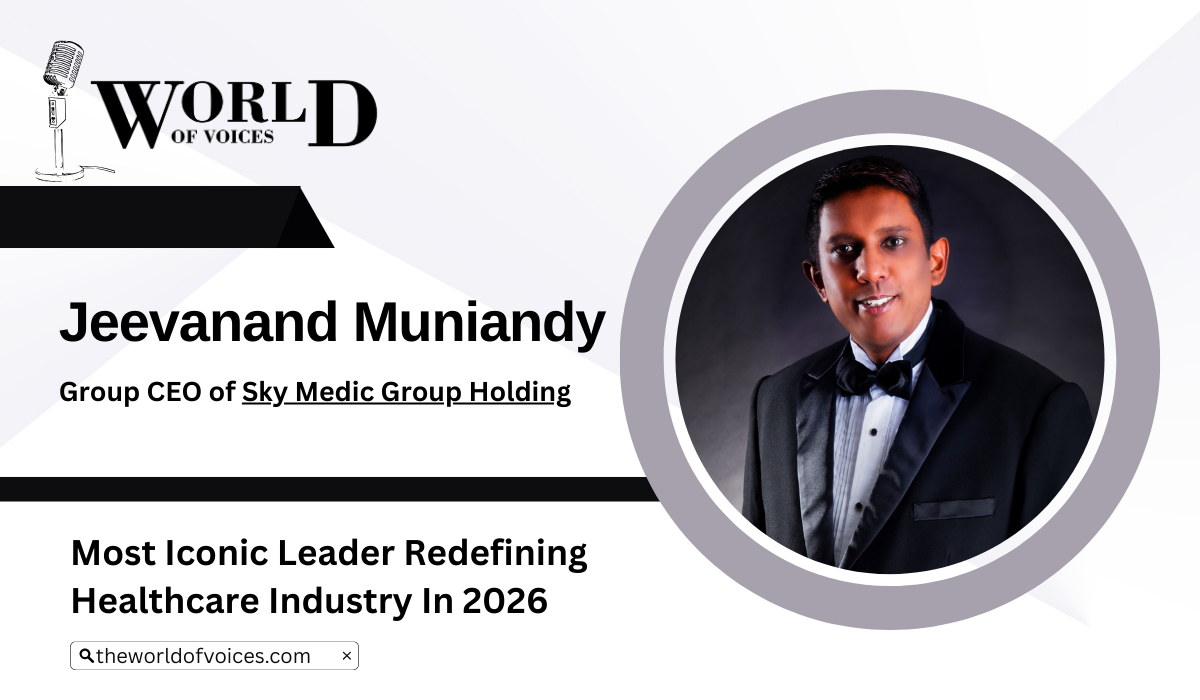
“Your first job doesn’t define your last destination—it builds the foundation you stand on.” The professional mission of Jeevanand Muniandy is to develop medical technology distribution methods to serve emerging markets in 2026. From his start as a restaurant waiter, Muniandy evolved into a business leader who now leads industry transformation. He has developed a business model that creates equitable access to healthcare through his work at the intersection of commerce and medical services. The interview covers two main topics: the remarkable career achievements of the subject and the belief system that guides his life, from which he operates.
The Foundation Years: Where Leadership Really Began
Jeevanand Muniandy acquired his most important life lessons from his experiences in a crowded restaurant before he began working with corporate executives and handling billion-ringgit business transactions. The healthcare leader developed during this time because he considered it his most important period of growth. The hospitality industry provided him with knowledge about authentic human relationships, which no management textbook could teach him. He developed tray-carrying skills while using his reading abilities to evaluate how people at the table reacted to him. He found that people do not express their actual requirements through words; instead, they demonstrate their needs through actions.
These two signals—an empty glass and a brief glance at it—taught him communication methods he would use throughout his life. He later identified the same interpersonal dynamics in hospital corridors. A surgeon will explain only his most important medical device doubts, while hospital administrators will keep their budget concerns to themselves. Muniandy acquired advanced skills to read unspoken messages, which enabled him to identify client requirements before they transformed into actual difficulties. The restaurant floor served as his initial training space for delivering empathy-based services, which still guide his present-day leadership practices.
Recognizing the Broken System
Jeevanand Muniandy shaped his career path after discovering that workers were not fairly recognized for their efforts. He observed throughout his initial professional years how highly skilled workers dedicated themselves to their jobs while their employers maintained strict payment systems that did not reflect their actual work output. Organizations treated productivity as something that appeared or disappeared without understanding its underlying causes. This observation ignited an obsession. He started to analyze what brings about success by investigating why certain teams succeed yet others who share their conditions fail to progress. He discovered that results depended on both targets and incentives, but process design controlled the actual outcome.
The companies concentrated exclusively on their quarterly results, which caused them to disregard the daily operations that contributed to those results. Muniandy recognized a fundamental truth: if you design the process right—if you align effort with recognition and build feedback loops into everyday operations—exceptional results become inevitable rather than accidental. His leadership method developed from this particular knowledge, which served as the essential foundation.
The Multi-Dimensional Education of a Leader
Jeevanand Muniandy’s various work positions throughout his career served as different ways to perceive the same fundamental truth. As a medical representative, he learned to handle rejection and remain persistent, even when opportunities disappeared. He learned that managing tasks is easy for department managers. The true challenge for leaders comes from guiding their teams toward success. He used his position as regional sales manager to learn how strategic plans develop from high-level perspectives and how effective strategies need to consider actual business conditions.
Muniandy already possessed an entire business operation plan in his mind when he began thinking about starting his own business. This plan detailed how enterprises functioned, along with insights into employee behavior. He learned about the demotivating factors that affect sales representatives during the rainy weather of Tuesday afternoons. He understood the things that make it hard for managers to handle their growing responsibilities when their budget restrictions force them to work with fewer resources. This knowledge came from actual work experience, which he gained through his extensive time spent working near the operational centers. Everything he developed later on was based on it.
Beyond Distribution: A New Definition of Impact
Jeevanand Muniandy’s region has experienced decades of operation by companies that functioned as efficient conduits that delivered foreign innovation to local markets. Muniandy identified that the existing model, which supported rapid development, needed to change in order to face future demands. The organization needed to establish its new role as creator instead of serving as the previous channel between two entities. His business dedicates extensive resources to local research and development work because the company needs to create solutions for local problems, not because this practice has become popular.
A device engineered in Frankfurt may not perform accurately in Kuala Lumpur due to differences in humidity, infrastructure, and environmental conditions. Temperature variations, supply chain conditions, and healthcare infrastructure create major differences across regions. Jeevanand Muniandy defines real technological impact as the development of systems that comprehend their operational environment, which consists of clinical, operational, and cultural elements. The company under his guidance transitioned from observing international innovations to developing new solutions that specifically target the difficulties faced by healthcare providers in developing nations.
The Moral Imperative of Technological Equity
The main motivation behind Jeevanand Muniandy’s work comes from his determination to challenge the technological gap in global medical systems. He questions why patients in Johor should use technology that lags five years behind what is available in Singapore. The clinical world lacks any reason to support this divide because it exists through commercial negligence. Muniandy considers it ethically wrong that markets base their importance on customer purchasing ability instead of actual medical requirements.
He believes that technological advancement should benefit human beings instead of humans working to advance technology. The organization uses two questions to determine the new technology’s commercial potential: “Where will this sell best?” and “Where will this matter most?” The organization uses this method to create valuable relationships with its audience, which helps them establish a lasting impact that improves human health. The company uses this approach to create equal access for all people through its business operations.
Process as Philosophy: Building for Sustainability
Jeevanand Muniandy has chosen to follow his process-oriented approach throughout his entire career because it enables him to achieve better results than other business executives who lead organizations. Most organizations, he observes, are outcome-obsessed. They worship the number and ignore the journey. Outcomes are lagging indicators because they show results but do not explain their underlying causes. Process serves as a method that can predict future outcomes. When Muniandy evaluates a team, he does not ask about their sales figures first. He inquires about their planning activities, their interactions with customers, and their methods of solving problems.
His conviction is simple: if the process is right, the numbers will follow—and they will be sustainable numbers that result from proper practices, not from temporary performance pressures. His organizational philosophy creates a framework through which he establishes his treatment of employees. A culture that values how work is done, not just what is delivered, creates psychological safety. According to Jeevanand Muniandy, organizations need psychological safety as their essential requirement for fostering creativity. People cannot create new ideas when they must spend their time worrying about potential punishments that will come from their mistakes.
Navigating Resistance in a Conservative Industry
Muniandy knows the reasons behind healthcare’s stubbornness toward change. The industry exhibits protective resistance because it operates in a way that requires people to stay safe. The system requires caution because human life needs constant operational stability. He believes that many innovators make a fundamental error when they try to break through resistance instead of treating it as an inherent part of the situation. His approach differs fundamentally. He presents evidence to counter resistance instead of showing excitement. He spends extensive time studying their actual situation before he asks them to accept any new solutions.
What are their fears? What would failure cost them? He uses the questions as a guide to develop a solution that serves as an evolution that solves existing problems between two recognized issues. The healthcare industry requires evidence-based solutions that demonstrate actual results because persuasive techniques are insufficient. Muniandy discovered that waiting patiently brings about actual changes in an industry where human life represents the ultimate value.
Creating Owners, Not Employees
Jeevanand Muniandy’s organizational culture development work establishes his unique legacy through his method of creating business ownership. He believes ownership cannot simply be assigned; it must be developed through the right structure. He developed his company according to his concept of “distributed entrepreneurship,” which he uses as an organizational framework. The department heads possess complete freedom to manage their departments, which enables them to operate at the same level as business founders. The team members handle decision-making responsibilities while they track results. They receive payment through a system that provides them with entrepreneurial-style financial rewards.
When people know their creative solutions will bring them personal success, they will stop working as employees and start acting as business partners. People achieve this change through existing structural systems that control their work activities. Muniandy has created an organizational environment that allows all employees to receive equal rewards for their efforts. The organization operates on a basis where people will automatically take initiative without needing to be asked. The organization establishes an ownership mentality at all employee levels because its systems provide rewards for this behavior.
The Blueprint for Aspiring Leaders
Muniandy provides guidance to newcomers in healthcare through his personal experience of nontraditional career development. He urges professionals to first identify the problems they want to solve in their careers. The first years of your career should focus on learning instead of pursuing job titles. You must know the medical issue that your work requires you to address. Hospital administrators experience economic demands that they must learn to handle. Patients experience mental distress when they need to manage unknown medical conditions. The comprehension of this matter demands direct experience with it.
He suggests that people should complete tasks that others choose not to complete. People should work in situations that make them feel uncomfortable. You should first let your mind become disoriented before you start learning from that state of mind. The healthcare industry does not allow any shortcuts to pass through verification processes. Leaders who remain in their positions understand their work through personal experiences, which they complete step by step. The path to real expertise requires you to take one step after another without any shortcuts. His personal experience developed this philosophy, which he now uses to train future healthcare leaders through his mentoring work.
The Horizon: What Legacy Looks Like
Muniandy’s vision for building his future extends beyond tracking market shares and measuring financial outcomes. He is working toward a future where the phrase “developing market” becomes irrelevant to medical technology. He wants to establish a world where a hospital’s location does not affect the medical equipment that doctors can use. He maintains that inequity is a design problem—and design problems can be solved. His organization invests in research collaborations and production resources and distribution systems that focus on making products available to users while maintaining high quality standards.
The legacy he hopes to earn will not be measured in revenue or market share. The measure will depend on how much he and his team reduce the gap between innovation and access. The entire purpose of this journey will be found in the moment when a remote clinician uses his technology to save a life twenty years from now. According to him, everything else exists as a minor aspect of the main issue.
Conclusion
Jeevanand Jeevanand Muniandy’s story resists easy categorization. The story exists outside both basic rags-to-respectability narratives and standard corporate ascent patterns. His journey demonstrates applied philosophy through a focus on work processes that directly influence results. The leader shows his dedication to technological equity through his process-centered approach, which helps people reach their full potential while he works to develop organizational structures.
Muniandy and his team provide essential leadership skills that match the industry’s needs, which uses human life as its primary measurement. The healthcare system currently experiences major technological, demographic, and economic changes, which create new challenges for leaders in the field. Such leaders provide guidance that functions as a compass. In a complex and often fragmented world, that may be the most important technology of all.
Read Full Digital Here: Most Iconic Leader Redefining Healthcare Industry In 2026