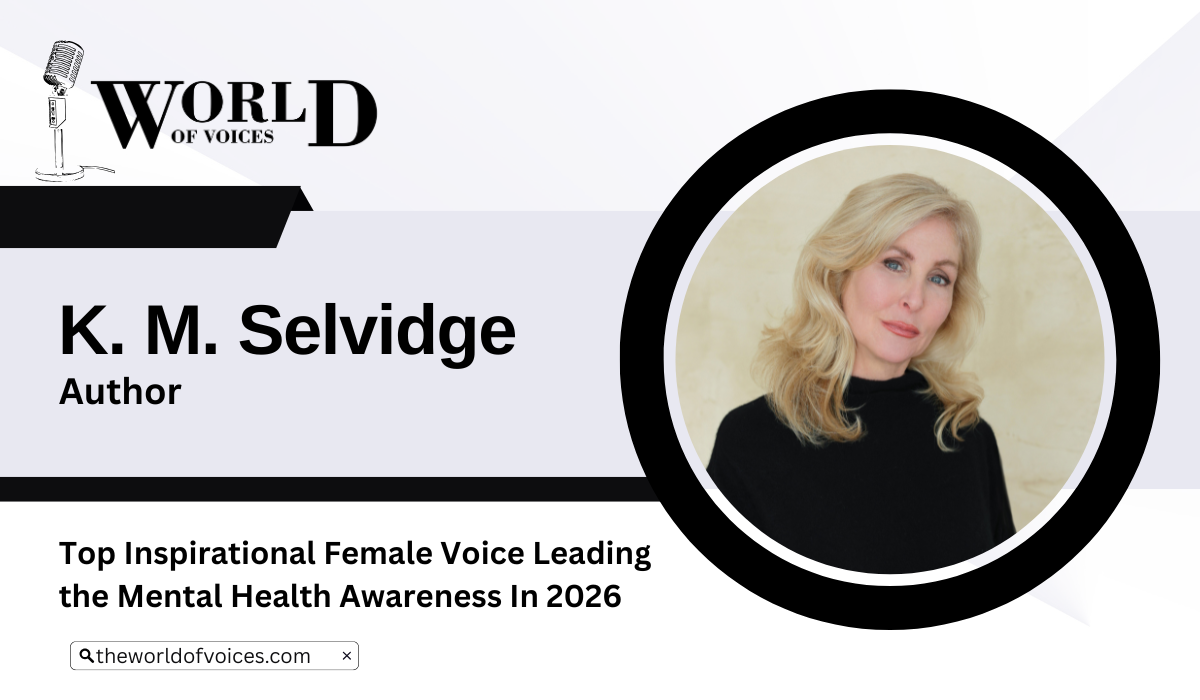
The present time shows us that people make digital noise, which prevents them from hearing the silent signals. When one speaks through their soft-spoken words, they can create a strong impact that resembles the power of ocean waves. The 2026 Top Inspirational Female Voice award goes to K. M. Selvidge because she uses a personal process to explain child anxiety through her storytelling work that creates understandable content.
For thirty years, Selvidge endured a quiet battle shaped by her brother’s mental illness, which she kept concealed throughout her life. The opportunity for her to share her story arose as she started to reconcile years of internal conflict, drawing upon her inner strength and establishing a firm resolve to persevere during challenging periods.
The Kloe series, together with her community work, has made her into a leading support system for families who experience separation because of external factors. The way she leads others stems from her honest nature instead of her need to control others. The fast medical system of today shows common practices that exist for people with special needs, yet Selvidge requests that we take a break from our work to focus our attention on a child while we hear their thoughts. A woman transformed her most painful experiences into a shared language that provides hope to others while proving that the most inspiring voices come from people who have experienced deep personal wounds yet have successfully overcome their obstacles.
The Long Wait Between Wound and Wisdom
Selvidge admits that for a long time, her past felt less like a lesson and more like a liability. She describes her first realization that her authentic life experiences would serve as her advocacy work through a moment that brought her complete inner understanding. “Deep down, I sensed that my own journey would someday play a pivotal role,” she explained, emphasizing that it was never about if but when. She needed to achieve resilience because her wounds had not yet healed enough for her to support others without experiencing emotional distress. Her leadership achieves optimal effectiveness in 2026 through this planned postponement.
Selvidge develops her method through careful and purposeful actions, which create distinct results from the social media trend of showing emotional weakness. She recognizes that effective leadership in mental health discussions about children requires a unique type of strength. She speaks from her experience of living through mental health chaos because her brother battles with mental illness. Today, when she speaks to a young child who feels invisible because a parent or sibling is consuming all the emotional oxygen in the room, she doesn’t just sympathize—she validates. “I speak from this understanding,” she says, “so young people know they are not alone.”
Breaking a Thirty-Year Silence with Ink and Courage
The story of Kloe remained buried inside Selvidge’s mind for three decades because its delicate nature made her unable to share it. The catalyst for finally sharing this deeply personal narrative came when she realized that the silence surrounding complex family dynamics was doing more harm than the truth ever could.
“Through my story, which contains all my imperfect parts and my valuable experiences, I want to show others that hope exists,” Selvidge states. “The Kloe Series—starting with Kloe’s New Start and Kloe’s New Friendship—was born from a desire to dismantle the walls of shame that families erect around mental health. Selvidge discovered that existing resources only supported diagnosed people while overlooking their siblings and friends who were left to handle their confusing behavior through fear and guilt.
The author wrote these books to demonstrate to overlooked children that their state of confusion should not be interpreted as a typical human experience. The 30-year wait was not about fear, but about readiness. She wanted to confirm that her story could create connections with people through shared understanding without causing distress and that it could help people understand her emotions without showing explicit content. The result is a literary safe space where children see their own fractured realities reflected in a manageable, compassionate format. By finally letting go of the story, Selvidge has given millions of family’s permission to start their own difficult, but necessary conversations.
Why Fur and Feathers Speak Louder Than Facts
The decision to use animals for Kloe’s narrative instead of human characters was made to create a more compassionate storytelling method. Selvidge recognized that children need animal characters to help them understand complex subjects that they cannot yet comprehend. “This approach offers a secure environment for them to process family difficulties,” she notes. The emotional armor that anthropomorphism provides protects children, no matter their race or culture, from emotional pain when they read about a cat or a turkey who experiences sadness. The audience observes Kloe’s character expressing her inner fear, particularly as it becomes evident that her mother is unwilling to acknowledge or comprehend her daughter’s distress. The process of distance helps people build their cognitive abilities.
The pathway enables children from all walks of life to develop empathy through animal behavior before they face the challenging situations which exist in their domestic space. Selvidge uses this format to better understand mental health issues while maintaining the child’s mental strength. Narratives teach resilience more effectively than lectures because people learn through stories.
Readers understand that they can recover from tough situations when they observe animal characters using help to overcome their challenges. “Children learn resilience is possible when they observe others who have successfully overcome difficulties,” Selvidge explains. The forest of Kloe’s world represents our actual world, but every storm in the book ends with clear skies, which show the reader what reality usually fails to provide.
The Nonprofit Executive Behind the Compassionate Heart
Prior to her career as an author, Selvidge served as Executive Director of Institutional Fundraising and led multiple capital campaigns for a range of nonprofit organizations over the course of more than 25 years.
The main foundation of her emotional advocacy comes from her extensive experience in managing nonprofit organizations and implementing corporate social responsibility (CSR) programs. She explains that her CSR roles taught her that “meaningful change stems from understanding real experiences and measuring human impact alongside results.” This professional discipline separates her from the well-meaning but often inefficient passionate advocate. She learned to establish partnerships and maintain institutional accountability through her experience working within the system. When she works with schools and community leaders, she shows two opposing traits: the passionate nature of a survivor and the rational thinking of a project manager.
She knows that people need empathy to succeed, yet this skill does not provide funds for book printing or animal therapy expenses. The nonprofit expertise she possesses enables her to create a broader impact that extends beyond individual readers to reach whole institutions. She works to make sure children and families receive proper attention while checking the actual effectiveness of support systems. “True progress is driven by compassion and trust,” she asserts, but she knows that trust is built on reliable delivery. In 2026 her powerful voice stems from her storytelling ability, which she uses to create lasting positive change.
Redefining the Inspirational Woman for 2026
The designation of “inspirational female voice” for 2026 requires Selvidge to bear special responsibilities that go beyond her ability to influence others. She defines her role in today’s world of perfect image management through her practice of speaking about her life experiences, which include both her challenges and her personal development. She rejects the notion that an inspirational figure must be unbreakable. She demonstrates her leadership abilities through a style that combines adaptability with openness and authentic human qualities. She uses her title to fight against the outdated belief that people should not ask for help because it makes them appear weak.
The most transformative thing Selvidge can do from her current role is to help people understand that healing is an unpredictable process. She does not present herself as a guru on a hill, but as a fellow traveler who happens to have a flashlight. “If my voice helps one person find hope and validation, which inspires them to put themselves first, this helps me achieve worthwhile goals,” Selvidge states.
This grounded perspective is what resonates with the 2026 audience, who are fatigued by performative activism. Selvidge provides naturalness to her audience because she does not use artificial behavior to create an impression. She understands that people experience both easy and difficult days while they must make their daily decision about whether to keep going through life. By sharing her own struggles and vulnerabilities, she reassures her followers that it’s okay to let go of the unrealistic expectation of constant happiness. She encourages them to embrace their authentic feelings, offering them the comfort and understanding that comes from knowing they are not alone in their experiences.
The Urgent Overhaul Needed in Schools and Communities
The school system and community infrastructure function as fire emergency systems—they may look like help is available, but they don’t truly protect or address the safety and security that is needed at home. “Most current mental health programs in schools tend to focus only on crisis moments,” she observes with frustration. The reactive approach does not effectively address the needs of children affected by the depression or the manic behavior of their siblings. The child experiences a gradual decline of self-esteem instead of showing immediate distress. Selvidge supports a fundamental transformation that would require schools to teach mental health as a mandatory subject throughout their academic programs instead of conducting special presentations.
She encourages educators to recognize signs of distress related to family problems, such as abrupt drops in academic performance or children becoming socially withdrawn. “If mental health education were woven into daily learning, every student could feel recognized and cared for, regardless of what’s going on at home,” Selvidge argues. She recommends that organizations ensure the presence of trained professionals with cultural competence at all times during operational hours.
The ideal community for her would require children to have immediate access to mental health support during school hours without needing to wait until emergencies occur. The change she wanted as a child has become her ideal world because teachers would understand that her backpack held emotional weight beyond the physical load of books.
Crafting Safe Spaces Through Consistency and Listening
The stigma associated with mental health concerns acts as an unspoken influence on communication. Selvidge is committed to fostering a safe environment through her storytelling efforts. She understands that children refuse to speak when they feel they face interrogation or judgment. The process is challenging because every participant needs to practice active listening continuously. She explains, “It involves putting away distractions and demonstrating that their words are important.” The presence of mental illness in a household creates an environment that results in unpredictable chaos. The needs of life become more vital than ever.
Selvidge suggests establishing easy routines, such as reading bedtime stories and regularly asking about what’s going on in their lives each day. These little moments give kids a safe space, especially during their five-minute break, when everything else around them feels chaotic. She believes that participating in shared reading activities and practicing mindful breathing with your children can help them develop emotional regulation, preventing behavioral problems before they escalate.
“By weaving these small, intentional acts into everyday life, “I hope to foster an environment where every child feels safe enough to express themselves,” she says. These exercises foster patience and resilience in challenging circumstances. When children feel secure and heard, they are more likely to disclose experiences that cause fear or sadness.
Selvidge’s approach, rooted in her personal background, emphasizes maintaining focus on the current subject matter without hesitation. She responds with a simple nod and acknowledges the difficulty of the situation. This approach mitigates mental health stigma by reducing shame through the implementation of empathetic acceptance.
Storytelling as the Most Innovative Tool in Mental Health
For Selvidge, mental health awareness innovation requires the storytelling arts to create new possibilities that extend beyond virtual reality headsets and complicated applications. The Kloe Series stands as her main innovative work, which she implements through her partnerships with schools and nonprofit organizations. She promotes narrative literacy as the essential method through which people should develop empathy. “Through my real-life storytelling I want to create a space for open dialogue while I share useful solutions,” Selvidge states.
Her innovative method uses books as an external icebreaker, which enables her to connect with people. Parents and teachers frequently struggle to discuss mental health issues because they lack the appropriate terminology. The books provide the words. The animal characters create a separation. The story delivers the dialogue. Selvidge advocates using “read-aloud” activities to facilitate therapeutic reception. The classroom experience of reading Kloe’s New Friendship establishes a shared experience, which helps students understand the subject matter.
Children who might have felt isolated suddenly realize that their peers are learning about the same struggles. Peer normalization through the natural interactions that students experience at elementary and middle school locations brings about powerful outcomes. Selvidge’s personal stories offer guidance on emotional intelligence, turning simple tales into effective educational lessons. She provides a type of mental health education resource through her work that enables school districts with no financial resources to access life skills content through her literature-based program.
Building a Generation of Empathy and Intrinsic Worth
The Kloe series will protect readers from experiencing mockery through its function as an early defense against instant judgment. “My hope is that both my voice and the Kloe series encourage the next generation to be open-minded and avoid jumping to conclusions about others,” Selvidge shares. The anti-stigma work needs this specific change because it represents an important development. Children must develop the ability to recognize pain because they need to understand that others experience their own difficulties through their “weird” classmate and “angry” neighbor. Selvidge wants to cultivate emotional detectives—children who look for the why behind the behavior.
She addresses those targeted for mistreatment by showing them their inherent value as human beings. “No matter the challenges you face, holding on to the belief that you deserve recognition and respect for your authentic self is vital,” she insists. Her complete message consists of two elements, which include showing empathy to others while she shows herself compassion. She wants to promote a generation that will succeed because they develop strength through their capacity to adapt and show compassion to others. The challenges of life will not break these children because they will remember Kloe’s story about finding stability through her relationship with others.
The Sacred Act of Protecting One’s Own Well-Being
The process of leading through trauma, which combines intense emotional elements, requires leaders to dedicate themselves completely to their personal safety. Selvidge demonstrates through her authentic expression of personal challenges that self-preservation in this field demands extreme dedication. “I am a constant work in progress,” she admits. The public often assumes that survivors who become advocates have fully processed their pain, but Selvidge dispels that myth.
She experiences the same risk of burnout and negative judgment from detractors that all people face. She maintains self-protection through her organized method of establishing personal limits. She uses self-care techniques that include walking in silence and talking to someone she trusts and doing breathing exercises when she needs to handle difficult memories from her book signing and speech events. She has discovered that people can only be open about their feelings to a particular extent. “It’s all right to ask for support when things feel overwhelming,”
Selvidge says, modeling the very behavior she teaches to children. Her authenticity serves as an essential element, which she uses to establish connections with her followers. People receive permission to withdraw from situations that require them to say “no” because they must first take care of themselves. Professional responsibility requires her to maintain her health because it protects her ability to serve others. Through her self-care practices, she maintains her emotional well-being, which enables her to share heartfelt compassion with others. This emotional reserve enables her to constantly share her authentic self with others through whom she discovers genuine possibilities.
The Legacy of a Thousand Gentle Exhales
This legacy describes how Selvidge exists between two different states of chaotic existence and controlled peacefulness while demonstrating that true leadership stems from people who have faced failures yet learned to recognize all their obstacles. The most inspirational mental health voice of 2026 delivers a crucial service to people who need support, although she cannot provide them with direct healing. The Kloe characters use their soft paws to demonstrate their CSR expertise, which they combine with their ability to maintain eye contact while listening.
She wants people to change their view of classrooms because they should become safe spaces. She wants parents to stop giving lectures, and she wants listeners to recognize siblings of sick people, friends of fragile people, and people who sit quietly at the back of the room. Her accomplishments will create a lasting impact through each child who discovers relief after disclosing their hidden truth. The story takes only one page of a lengthy narrative, which K. M. Selvidge now introduces to readers through her personal experience and persistent optimism.
For more information on Kathryn Selvidge, please follow her on Kathryn Selvidge.16 – Facebook; @Selvkat – Instagram; Kathryn Selvidge – LinkedIn; or check out her website,
Digital Magazine: Top Inspirational Female Voice Leading the Mental Health Awareness In 2026