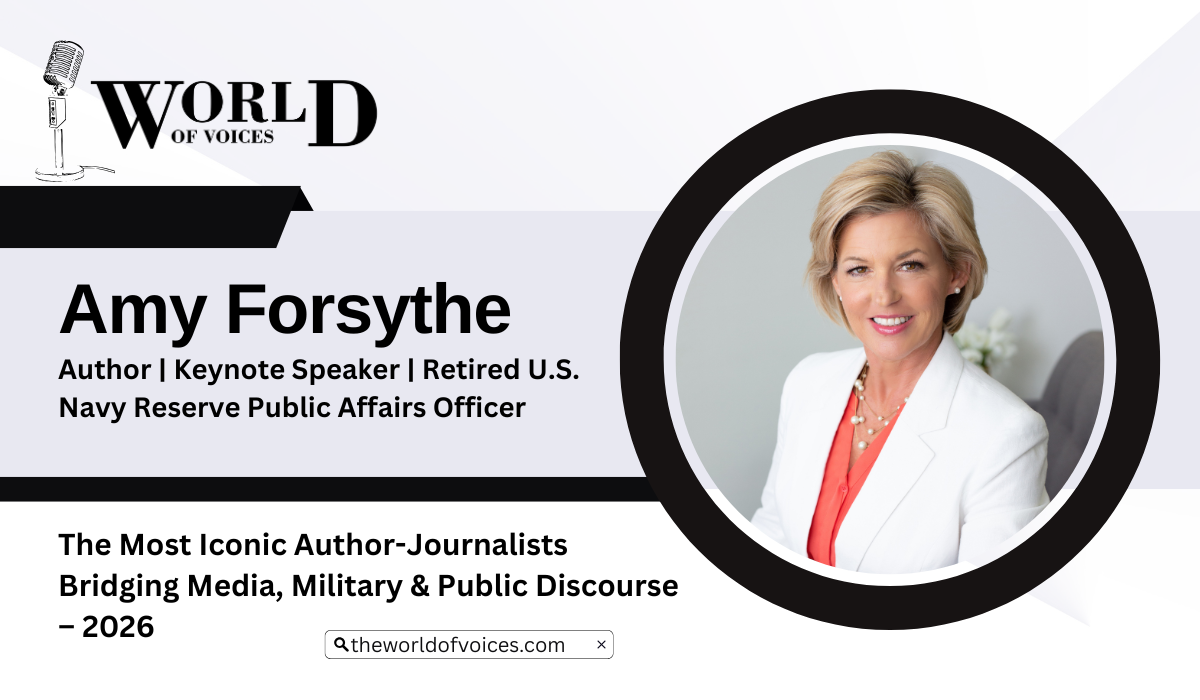
Some people write stories. Others live them. For more than three decades, Amy Forsythe has done both.
A Marine veteran, combat correspondent, retired U.S. Navy Public Affairs Officer, journalist, author, speaker, and media entrepreneur, Forsythe has spent her career documenting some of the most significant moments in modern military history, while also doing that quietly hard task of bridging the gap between military service, media, and the public, sort of day to day.
Her work has taken her from conflict areas in Iraq and Afghanistan to red carpets in Hollywood, from military exercises across Latin America to keynote stages up and down the country. Still, even with all the different rooms she has kind of moved through, one theme stays in place, the power of storytelling to connect people.
“I’ve always believed that stories are bridges,” Forsythe says, “When people understand each other’s experiences, they become less divided and more connected. Storytelling helps us find that shared humanity.”
That idea has become the footing for a career that stretches more than 30 years across military and civilian communications.
The Beginning of a Journey
Forsythe’s journey into writing and journalism started way before she really understood what journalism, um, was supposed to be. She had this constant pull toward stories—where they begin from, who is telling them, and how they sorta nudge the way people make sense of the world right around them.
“Curiosity has opened more doors for me than any credential ever could.”
When she joined the U.S. Marine Corps as a combat correspondent, she realized storytelling wasn’t only about putting words down in neat paragraphs. Not really. It was about safeguarding history. Every photograph, every conversation, every deployment, and each news report turned into a sort of historical breadcrumb trail, something that future readers could still follow.
Growing up, she was the kind of person who just… watched. She noticed people, conversations, and those small details that other folks tend to pass over. And once the military folded that curiosity into her days, she found herself documenting things that ranged from humanitarian missions to combat operations. She came to understand that history isn’t made only by high-ranking leaders or presidents. It’s also made by ordinary people doing remarkable work under harsh, tangled circumstances.
Being trusted to tell these accounts, that’s what taught her the weight of it. Storytelling carries privilege, yes, but also a responsibility that doesn’t let you drift. There wasn’t one single moment that “decided” everything. It was more like a chain of moments, interviewing Marines and Sailors when they were coming back from missions, seeing families reunite after deployments, and recording operations that later, would end up inside military history books. Over time, it clicked that she wasn’t just collecting facts. She was keeping memories alive, protecting lived experiences that might otherwise disappear.
That’s when she finally understood, storytelling wasn’t merely a job. It was a calling, and kind of a quiet one but still undeniable.
Career & Purpose
Forsythe has spent her entire career standing at that intersection of media , military, and public life, kind of all at once, even if people try to keep those worlds apart. Military communities often operate separately from civilian communities, and journalists just… frequently struggle to access or understand military culture, like not in a malicious way but still, it happens. And because she is both a veteran and a journalist, she is positioned in a way that lets her help close that gap, more naturally than most.
Her goal has always been to create understanding, not just “awareness” or some quick headline sort of thing. When citizens better understand the people who serve, and when service members better understand how media shapes public perception, everyone benefits, even indirectly, even over time.
Storytellers are using the “The First to Go and the Last to Forget” and that’s why it’s such an important role in our society. “Sharing stories and bridging the gap between generations to pass down shared knowledge of language, bravery, culture, etc. is more than a job, it’s a calling.”
She learned early that complexity really matters , even if people act like it doesn’t. The world rarely goes neatly into those tidy little narratives, you know, the ones that look all good on paper. Most stories come with multiple truths, competing perspectives, and a few nuances that don’t always sit cleanly inside a headline, or a social media post, for that matter. When she covers military operations, public affairs, crisis communications, and veteran issues, she keeps running into the same lesson , context is often every bit as important as the facts themselves. Her job , in practice, is to help audiences understand not only what happened but why it happened , and why it matters, the whole thread, not just one knot.
She describes her work without making it a bigger deal than it needs to be. She helps people understand each other through stories. Whether she’s writing about military service, public policy, emerging technology, veterans’ issues, media ethics, or human resilience, the mission stays the same. Meaningfully connect people through accurate, responsible storytelling . Then she’ll sometimes say it in simpler ways , like she’s a bridge builder. The stories are , basically, the bridge.
Your Work & Impact
Forsythe hopes that readers just walk away with a little more understanding, maybe also some real curiosity. The best stories don’t really tell people what to think. They kinda nudge people to think more deeply, like a slow pull. They challenge assumptions, they stretch empathy, and they can spark meaningful conversations. If someone finishes one of her stories with a wider perspective than they had before, then she has done her job and yeah, it’s as simple as that.
She tends to pick stories that matter, especially the kinds that might otherwise get left in the dark. She is drawn to people operating quietly behind the scenes—those whose contributions are huge but often overlooked. Veterans, military families, first responders, community leaders, and everyday citizens keep showing up with remarkable stories that deserve a wider audience. And she keeps asking this kind of plain question, “Why should someone care?” If the story can help people understand themselves better, their communities, or the world nearby, then it’s worth pursuing.
Out of all the topics Forsythe has covered, a few have landed in her life in a lasting way. Her recent work on ibogaine treatment for veterans and trauma recovery really hit hard. Unlike some other pieces she has done, this one became personal. It challenged assumptions she carried for decades and pushed her to look again at the relationship between trauma healing, mental health, and personal growth. The whole experience also reminded her that journalists are human beings too. Sometimes the most important stories are the ones that change you while you’re telling them, and that part is not small at all.
Storytelling & Responsibility
Responsible storytelling , for Forsythe, basically means telling the truth as accurately and as fully as you can, even when it gets messy. In a time where information travels way faster than it used to, there’s this kind of constant pressure to be first. Still, she thinks it matters more to be right than to be early. Responsible storytellers also get that words have real effects. Stories can nurture trust, strengthen neighborhoods, and deepen understanding—but they can also sharpen division if they’re handled in a careless way. Accuracy stays the base, the kind of bedrock for credibility.
She balances honesty, sensitivity and precision by starting with the facts and then keeping them in view. After that, she reminds herself that every story includes real people, not just names on a page. Precision should never be traded off for emotion, but empathy should never be treated like a speed bump you can just roll over quickly. She tries to meet every interview, and every story, with respect, with curiosity , with a certain amount of humility too. People tend to place a lot of faith in journalists when they share their experiences, and that faith should never be brushed aside.
In her mind, journalists are translators. They take complicated topics, institutions, and events and help an audience understand them, especially when those things might feel far away or confusing. They add context, they ask hard questions, and they help preserve the historical record. And when journalists are at their best, they don’t just tell society what to think. Instead they supply the information people actually need, so they can decide for themselves.
Leadership & Influence
Forsythe keeps her authenticity in this fast, really fast changing media landscape by staying kinda grounded in her values. Technology changes. Platforms change. Algorithms change. But human nature doesn’t. Authenticity, to her, is not this big performance, it’s being consistent about who you are , what you believe and why you do the work. She’s noticed that audiences tend to connect with genuine curiosity and straightforward honesty way more than with polished perfection.
Covering conflict has, honestly, been some of the most difficult moments of her career, there’s no real way around that. Combat environments push journalists into decisions that have to happen quickly, while still keeping accuracy and professionalism intact, even when the pressure gets heavy. And more recently, the info environment keeps shifting, like day to day. The spread of misinformation, less confidence in institutions, and the influence of artificial intelligence, all of that means journalists have to adapt constantly, but without dropping their ethical standards.
Those experiences built her resilience. Military service taught discipline. Journalism, curiosity . Leadership brought responsibility . And together those things reinforced how important adaptability really is. The world keeps moving , and growth often shows up when you accept uncertainty, instead of trying to fight it off.
Values & Ethics
Forsythe has a handful of core values that pretty much guide her choices and how she shapes a creative process, integrity, curiosity, service, and accountability. Integrity is the thing that keeps her anchored to the truth. Curiosity makes her keep asking questions, again and again, and even when the answer feels obvious. Service reminds her that the storytelling shouldn’t just sit there, it should actually add something useful to society. And then accountability, it keeps her facing up to the responsibility that comes with a public voice, not sort of “around” it, but directly.
So why does integrity matter so much in modern journalism? Because trust is everything. Once trust is gone, it’s unbelievably hard to get it back. People today have access to more information than any generation before, but still plenty of them struggle to figure out what’s credible in the middle of all that noise. Journalists who show honesty, transparency, and fairness over time help build public trust in information itself. Integrity isn’t some shiny competitive advantage. It’s a requirement.
The Evolution of a Storyteller
Over the years, Forsythe’s work kind of expanded far beyond what people normally call traditional journalism. She wound up as a sought after speaker, communications strategist and an advocate for veteran voices, not just that. She also authored books, started new media initiatives and helped organizations get better at how they speak to audiences, in a more grounded way.
Lately, she went further and founded MediaBridge.io , a platform meant to connect journalists with experts and sources. The whole idea came out of something she saw again and again during her career. Journalists are often under huge pressure, and yeah, with tight deadlines that don’t really care about anyone’s schedule. Meanwhile, there are incredible subject-matter experts whose knowledge just never reaches the public, simply because there isn’t a solid, efficient connection route.
MediaBridge fixes that gap by building trusted links between media professionals and the people who actually know the topic. For Forsythe, this feels like a natural continuation of her lifelong mission. Even now, at its core, it’s still about helping people locate the right stories, and the right voices, before the window closes.
Set to launch in Fall 2026, MediaBridge.io is an AI-powered platform designed to help journalists quickly connect with credible experts, spokespersons, authors, executives, veterans, and thought leaders across a wide range of industries. Created in response to shrinking newsrooms and increasingly demanding media deadlines, the platform streamlines the sourcing process while making trusted voices more accessible to reporters, producers, podcast hosts, event organizers, and public affairs professionals. By bridging the gap between media professionals and subject-matter experts, MediaBridge.io aims to foster more informed public discourse while creating meaningful visibility opportunities for qualified contributors.
Finding Meaning in the Hard Stories
Among the many topics Forsythe has covered, some of them left a lingering personal impact, a little more than she may have expected. In recent years, she has been putting a lot of time into looking at veteran mental health, trauma recovery , and the newer treatment directions. And one project in particular sort of pushed her into places she didn’t really plan on going.
Her exploration of ibogaine treatment and trauma recovery meant she had to get past just observing, and actually sit with questions that were deeply personal about healing, steadiness, and transformation. “Some stories change you while you’re telling them,” she says. That whole experience kind of confirmed something she has learned over and over again during her career: the strongest narratives are often the ones that show the same basic human struggle. “We all want purpose. We all want connection. We all want to understand ourselves better,” she says. “The specifics may be different, but those themes are universal.”
The Importance of Integrity
As media keeps evolving, Forsythe seems to stay anchored on one principle, the sort she treats as non negotiable, integrity. In a world now shaped by algorithms, artificial intelligence, and basically nonstop streams of content, she says she thinks credibility is journalism’s most valuable currency, like that.
“Technology changes. Platforms change. Human nature doesn’t,” she says, kind of plainly. She’s less concerned about tech disruption than she is with the slow erosion of trust. “We live in a time when people have access to more information than at any point in human history,” she says. “The problem isn’t finding information anymore. It’s figuring out what is credible.”
Because of that, Forsythe keeps stressing accuracy along with transparency, and also accountability in the way she works. “Being first isn’t as important as being right,” she says. You can feel that perspective comes from decades of experience, in places where errors come with real world consequences, not just theoretical ones. Whether she is reporting from military operations, advising organizations during crises, or building media platforms, she keeps following those same values.
“Trust takes years to build, and moments to lose.”
Looking Toward the Future
As artificial intelligence reshapes the media landscape, Forsythe sees this as both an opportunity and responsibility ahead, kind of. Rather than panicking over technological change , she thinks communicators should learn how to work with new tools while staying anchored in classic principles, even if it feels old school sometimes.
“ The future belongs to people who can blend technology with credibility ,” she says. She predicts that human judgment, context, and authenticity will become ever more valuable as AI-generated content becomes more common, almost like a background noise that you still have to sort through. “People aren’t just looking for information,” she explains. “They’re seeking perspective, lived experience, and trust.” Forsythe believes the next generation of journalists will need technical agility , along with solid ethical footing. “The tools will keep shifting,” she says. “The responsibility won’t.”
A Legacy of Connection
As she gets closer to retirement , after more than three decades inside the military, Forsythe seems to care less about accomplishments and more about impact ,and somehow you can feel it in the way she talks. When she is asked what legacy she wants to leave behind, her answer comes back again to storytelling.
Throughout history, she says, communities have leaned on designated storytellers, to keep hold of knowledge, culture and collective memory. From tribal historians to war correspondents, the responsibility stays surprisingly steady across generations. “The tools have changed , but the mission hasn’t,” she says.
For Forsythe, the whole point has always been about helping people understand one another. If future generations remember what she did, she wants it to be for that reason. “I hope people recognize that I tried to preserve important stories and help others tell theirs,” she says.
In a world that seems increasingly built from noise, speed, and division , that aspiration sounds almost simple. Still, it might be the most important. Because stories, she reminds you, are more than information. They are how societies remember. They are how communities connect. And for storytellers like Amy Forsythe, they are how we leave the world a little more understood than we found it.
Key Takeaways from Amy Forsythe
| Before the Journey | After the Journey |
| A curious girl who paid attention to everything | A decorated veteran and award-winning journalist |
| Learning the craft of writing and photography | Preserving history for future generations |
| Observing from the sidelines | Standing at the intersection of media, military, and public life |
| Asking basic questions | Asking hard questions that change you |
| Building skills | Building bridges |
| Serving in uniform | Serving through storytelling and technology |
Pull Quotes
“Curiosity has opened more doors for me than any credential ever could.”
“Have a Clear vision. Lead with an Open heart. Allow yourself space for New Energy.”
“I’ve always believed that stories are bridges.”
“History isn’t just made by famous people. It’s made by ordinary people making extraordinary decisions under difficult circumstances.”
“The best journalism doesn’t tell people what to think. It helps them understand.”
“Being first is not as important as being right.”
“Trust takes years to build and moments to lose.”
“The tools have changed, but the mission hasn’t.”
“Storytellers are The First to Go and the Last to Forget.”
More about MediaBridge:
MediaBridge.io is an AI-powered expert discovery platform that helps journalists, podcasters, producers, and event organizers find credible voices for interviews, stories, panels, and speaking engagements. Through authority profiles, media opportunities, and AI-powered tools, MediaBridge helps experts and creators become more visible, discoverable, and media-ready.
Or
MediaBridge.io is an AI-powered platform designed to connect journalists, podcast hosts, producers, event organizers, and brands with credible experts, creators, authors, speakers, founders, veterans, and thought leaders. Combining professional profiles, media opportunities, authority scoring, and AI-powered discovery tools, MediaBridge helps individuals increase their visibility, credibility, and influence while making it easier for media professionals to find trusted voices on demand. The platform’s signature Media Authority Profile (MAP™) and Ask My Twin™ features transform static online profiles into interactive, media-ready assets that help experts get discovered, booked, and interviewed more often.
Website: www.mediabridge.io
Founder: Amy Forsythe
Launch: Summer 2026
Digital Link: The Most Iconic Author-Journalists Bridging Media, Military & Public Discourse – 2026