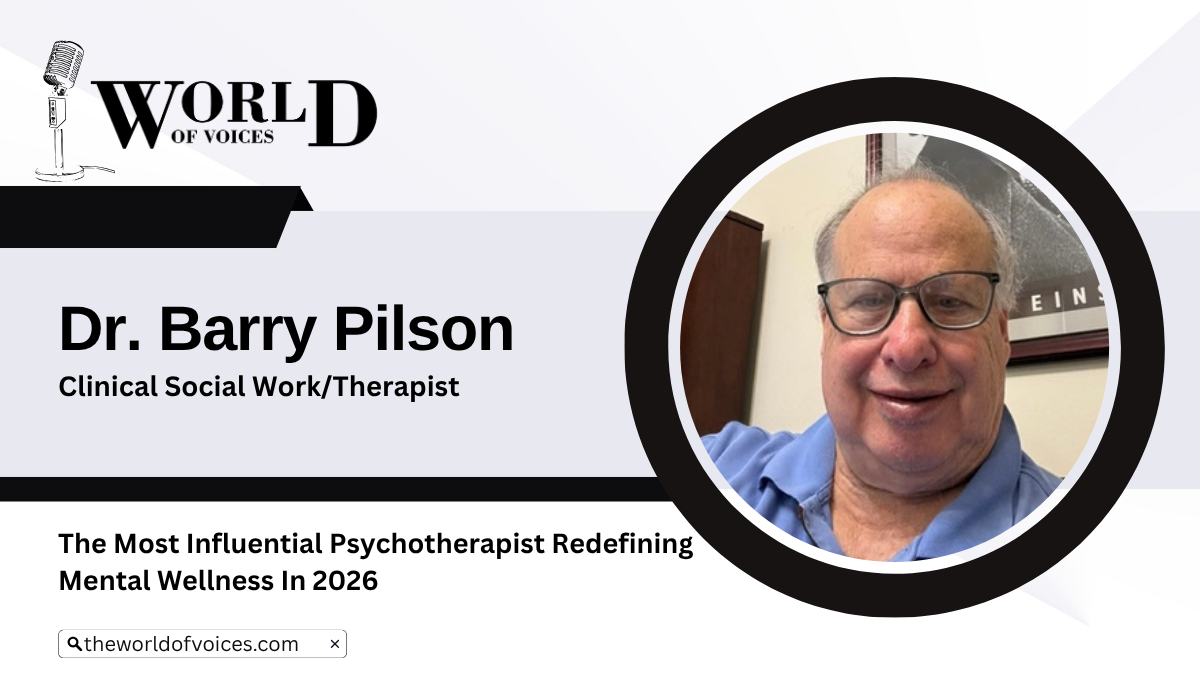
In an era of quick fixes and digital distractions, one man has spent five decades doing something that’s kinda radically simple yet somehow profoundly transformative: listening. Dr. Barry Pilson, a self-employed psychotherapist working out of the vibrant , complex and resilient city of New Orleans, is a kind of voice of wisdom in a field that seems more and more crowded with trends, plus extra credentials.
His path from the protest-filled campus of UC Berkeley to the hauntingly beautiful streets of Louisiana isn’t just a career thing, it’s more like a living testament to how powerful genuine human connection can be. This is the story of a therapist who doesn’t treat therapy as a way to merely lessen stress, but more as a re-direction of it , turning it toward resilience, joy, and the abundance of life forces.
From Berkeley To New Orleans: A Foundation Forged In Upheaval
Dr. Barry Pilson’s interest in psychotherapy and mental health began as a young student at the University of California, Berkeley. It was the early 1970s when the campus was rife with political consciousness and protest. It was the height of the Vietnam War. Going to college enabled one to have a deferment from the draft. However, to be clear, he would have been in college anyway. There was social upheaval on campus and outside as young people were seeking to navigate their lives through the morass of confusion, contradiction and hyperbole. Drugs were a dominant player as well as various sub-cultures encouraging manifold lifestyles and emphasizing alternative communities.
Dr. Barry Pilson was involved in a community center called the Walden II Lemonade Stand. What a wonderful moniker. At the center, various conscious groups and activities were promoted with the ideal of promoting a more just and equal society, the ideals spelled out in the constitution and declaration of independence. It was an enlightening experience until one day someone stole all the equipment and items out of the center, forcing it to close. So much for openness. Reality slams the door often on ideals.
Boundaries and guardrails are issues that need to be implemented as we swim through the rough waters of life and nature. A turning point for him in light of these issues was the Watergate hearings and the eventual resignation of Nixon. To see the constitutionally formed government work regarding accountability affirmed his faith in the guardrails of the “system”.
The Path To Practice: Choosing Social Work Over Psychology
He began graduate school in 1974 in the school of social work. His dream was to be a psychotherapist. He was not interested in saving the world or making it a better place. He was simply interested in how people function in the tranches of motivation, aspirations and decision making. Social work graduate school did fit his internal wants at the time. As a senior honors student with excellent grades at Berkeley, he applied to top psychology graduate programs in the country.
He learned that these programs accepted 3 to 5 students initially every year. A mentor guided him to apply to social work school, given his aspirations. He went to social work school in New Orleans. Fifty years later he remains a resident of New Orleans and a self-employed psychotherapist. From California to Louisiana, what a transition. Looking back, with hindsight, he is glad about the decisions he made.
A True Fellowship: Lessons From The Trenches
Over the years, before entering private practice, Dr. Barry Pilson worked in agencies and hospitals, including ten years in inpatient addiction treatment. One of his first jobs out of graduate school was delivering counseling services to federal probationers and parolees who were identified as substance abusers and assumed this was the basis of their criminal activity.
Of course, the issues were much more complicated. For him, besides being introduced to these complexities, the process that occurred was sitting in individual and group sessions all day listening to life stories, perspectives, insights and philosophy. Listening for 6 years gave him a foundation and educational experience which influenced his life and work forever. He could not have received a better education talking to this population and is forever grateful. This was a true fellowship.
The New Orleans Zeitgeist: Practicing In A City Of Ghosts
New Orleans is an interesting community, a mosaic of poverty, privilege, subcultures, violence, love, graciousness, corruption and fairness, racism and openness. Once you seem to touch something and feel you understand it, a more complex and powerful force sweeps you in another direction, never dull, somewhat dangerous and always intriguing. It is in this zeitgeist that he has practiced psychotherapy. This is a community that is historically impacted by natural disasters, hurricanes, epidemics and disease, especially prevalent in the 19th century, before scientific medicine mitigated these disease forces. These traumas are like ghosts and shadows that haunt the community. Some of these manifest in the many ghost and haunted stories that add to the lore of New Orleans.
Katrina And Resilience: Staying When Others Left
Hurricane Katrina in 2005 helped solidify Dr. Barry Pilson’s work in mental health. He was experienced enough to be of help to individuals and be a part of rebuilding the community. To be clear, the effects of this disaster, in the context of historical traumatic events, continue to permeate the lives of many.
For instance, in his last session with a client he has seen for 20 years, beginning shortly after Katrina, her gutted house since 2005 is about to be renovated. Of singular importance, however, is that as she wandered homeless, seeking drugs in a damaged community right after the storm, she is sober today and understands how to take care of herself, including her mental health, despite family of origin trauma and her own personal traumas over the years. Resilience and good decision making are her current guardrails, based on her experiences and ability to process them.
After Katrina, the prevalent decision for most people in New Orleans was to leave or stay. Many people, due to financial circumstances and employment issues, had to leave. They had a choice. It was clear to him and his wife that they would stay. They had just built their architecturally designed home five years prior to the storm. Their children and grandchildren were here, though their grandchildren evacuated to Texas and stayed there due to work circumstances of their parents. Their house had to be rebuilt following the storm. Navigating through insurance claims, contractors, supply chains, do-gooders and con artists was a lifelong lesson of resilience and acquired wisdom. He is glad they stayed.
A New Paradigm: Beyond The Myth Of Stress Reduction
To focus on mental health and psychotherapy, here are some of the lessons Dr. Barry Pilson has learned. First, mental health and psychotherapy are absolutely embedded in biology. The brain and its functioning is inextricably linked to this work. Self-care is necessary for the well-being of the individual and the prevention of stress in brain functioning. This is no longer a mystery. The brain/body as a dichotomy is a falsehood, first taking hold in the enlightenment, but now it is understood that the nervous system links all organs and communicates through hormones and neurotransmitters manifesting in metabolic processes. This is a simple version.
Structures in the brain guide the functioning of the organism, seeking homeostasis. To summarize, a basic principle of physics for every action, there is a concomitant reaction. This describes the homeostasis principle of the brain. When out of balance, a process called allostasis, defined as achieving stability through change, may induce new set points or triggers which influence regulation. Allostasis is a temporary state as the brain seeks homeostasis or regular functioning as its base.
The process described above in everyday activity is called stress. Stress has a bad name. In current discourses, mental health treatment is seen as a means to reduce stress. For instance, we have a pharmaceutical industry that markets drugs that are anti-depressants and anti-anxiety and viewed as vehicles to reduce stress.
He has learned that psychotherapy as a means of treatment is not about reducing stress. It is about re-channeling the opportunity of allostasis to learn better coping strategies and make changes that increase reward and joy in your life, leading to resilience and empowerment. It is about utilizing our built-in reward system, rather than reducing stress, which in essence is about mitigating our fear responses.
The Problem With Methods And The Power Of Process
The methods of psychotherapy vary. This is a problem in the field. 50 years of research has shown that there is not a superior method of therapy. However, the method needs to match the issues and history of the individual. In general, the method of therapy contributes about 15% to positive therapeutic outcomes. Despite the research, many therapists market themselves as specializing in certain methods, which is reinforced by a larger structure of certifications, issued by organizations, with no real legitimacy, other than their criteria for certification. As a therapist, your expertise is in the role of a clinician: diagnosing, assessing and creating treatment collaboratively oriented plans as you follow through with the therapeutic process.
To reiterate and clarify, the stress issue in mental health treatment is not necessarily to reduce stress but to explore its origins. You want to process it rather than reduce it and/or run away from it, which can lead to a true cortisol reduction and out of the fight/flight/freeze syndrome. Through alcohol and drugs and a variety of escape behaviors such as shopping and gambling (both now highly encouraged by the media) too much is focused on avoidance, which solves nothing and leads to an uptick in dependence, falsely creating a feel-good experience. This can lead, over time, to more stress and possibly set one up for addiction, where reward seeking becomes distorted through destructive behavior.
His vision of therapy is to access the built-in reward system of the brain via constructive behavior which leads to desired and helpful outcomes. The reward-dopamine system is best utilized to learn sustained helpful behaviors. The dopamine surge associated with goal directed constructive behavior influences our desires, appetites and wants while triggering behaviors that if habituated increase positive outcomes. Quick escape behaviors hijack the dopamine system after giving a “yahoo” moment without the concomitant learning that directs us positively. It also impedes salient communication as attachment to outside devices hijacks our attention.
The Educational Model: A Blueprint For Growth
A good example of an engaging system that can helpfully connect us to positive outcomes is our educational system. He is not talking about the content of what is taught. That is another issue. He is talking about setting goals, testing, and evaluating objectives that lead to fulfillment of goals. Doing well on a test or finishing a project that encapsulates productive learning and constructive outcomes is the basic model for growth and development. It is seemingly old-fashioned, but it is very effective. Does anyone feel bad if they do well on a test or project that is objectively assessed?
Therapy is best described as a process. This is where measuring needs to be executed. Processing is important in regard to accountability and change. Again, a simple example is losing weight. There is no ideal weight. Are you engaging in processes that increase healthy habits, eating certain foods, and engaging in activities like exercise?
The outcome of weight is dependent on these processes. This is where measurement needs to be implemented, not the actual weight number. In summary, utilizing the biology of our organism in relation to learning in an adaptive environment needs to be the guiding principle of psychotherapy. Change oriented dynamics that can be monitored and measured are the tools. We have an abundance of tools that can be utilized in this process, just as there is an abundance of tools that shape and develop physical strength, mobility, and endurance.
The Heart Of Therapy: Relationship, Conversation And The Infinite Dialogue
The central aspect of psychotherapy, that is its watershed apotheosis, is the relationship between therapist and client. 50 years of research shows the best predictor of positive therapeutic outcomes is how the client feels about engaging with the therapist. There are tricks to facilitating this engagement. They can be utilized. This includes availability, consistent scheduling, setting of the room, clear boundaries, and, of course, the most salient feature, confidentiality.
In his experience, the most dynamic and salient process is the actual conversation between therapist and client. The therapist’s role is to bring their overall culture, experience, knowledge, empathy, genuineness, and curiosity. A curious therapist is important in relation to effective dialogue. Engaging, ongoing dialogue is an art influenced by principles. The relationship develops over time. This is the paradox of therapy. Time is infinite, yet like quantum physics, past, present and future are entangled such that emergence via exact prediction is not concrete, but stochastically emergent. This describes the impromptu dialogue between two humans that is contained in that particular unit.
In the special dimension of the therapeutic hour, is a crucible of connection, change, experience, knowledge, emotions and techniques that can create new dimensions of reality. It has to include the ingredients of the current dimensions and ingredients of the past and present that are identifiable. Mental health is the embodiment of emotions, biology, spirit, culture, history, life and health, interacting in never ending cycles. The opportunity is to bring a temporary process to an infinite system, creating meaning and joy.
The Never-Ending Conversation
One final statement. The conversation or dialogue between therapist and client is never ending. Issues are constantly repeated and reiterated. The opportunity is to rehash issues, just as a repetition compulsive process reveals ongoing and past traumas. In this way, levers of change can be accessed leading to a re-organization of dynamics in a consistent, focused process bringing joy, meaning, and the abundance of life forces.
Dr. Barry Pilson has spent fifty years proving that the answer to our deepest struggles is not in escaping them. It is in sitting with them, processing them, and transforming them into wisdom. He does not promise a quick fix.He promises, uh, something way more valuable— a real human conversation that doesn’t actually have an end, a kind of space where past, present, and future all get tangled up together, not for decoration but for growth, and a bond that ends up being this crucible for making fresh dimensions of reality.
In a world that keeps selling us the illusion of “stress reduction” he hands us the lived reality of resilience. In a culture addicted to the “yahoo moment,” he teaches us the enduring power of the process. That is why, in 2026, Dr. Barry Pilson stands as one of the most influential voices redefining mental wellness—not by making life easier, but by making it richer, deeper, and infinitely more meaningful.
Read Full Digital Here: The Most Influential Psychotherapist Redefining Mental Wellness In 2026