By The World of Voices Magazine
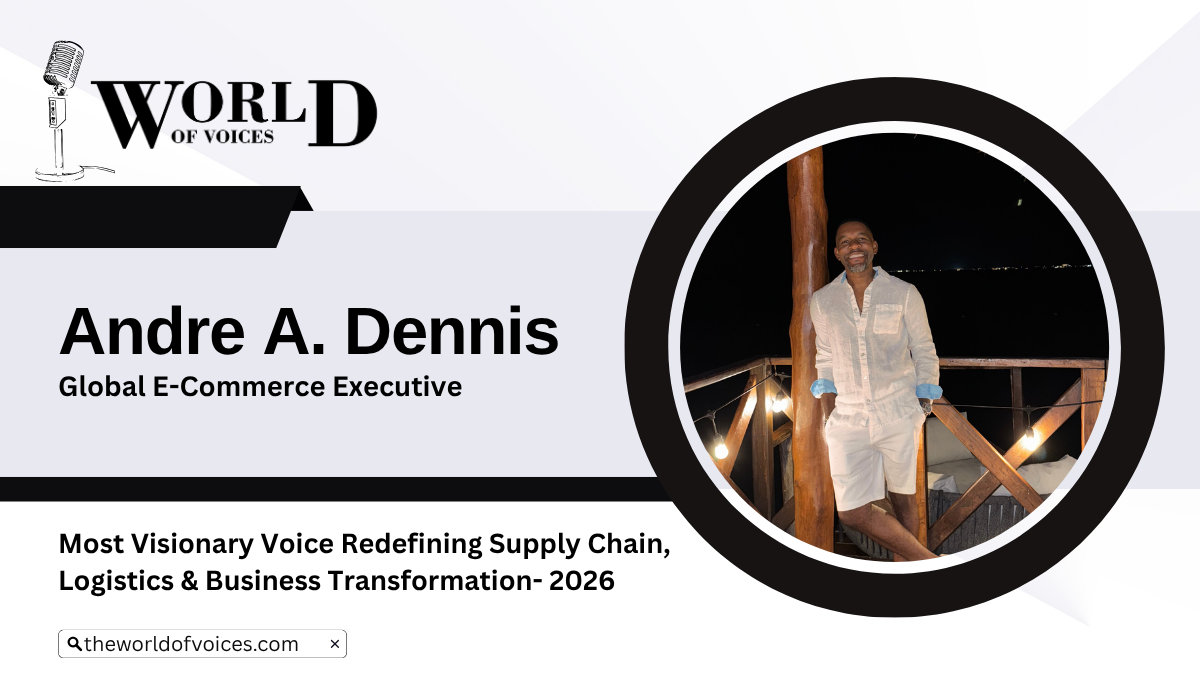
Andre A. Dennis doesn’t start conversations by talking about himself.
He starts by asking about you. Your challenges. Your goals. what keeps you up at night. It’s a small thing, but it tells you everything about who he is and how he leads, really. In a world obsessed with titles, credentials, and personal branding, Andre stays refreshingly different, like almost oddly so. He listens more than he speaks, asks questions more than he hands out answers. And he genuinely thinks that leadership isn’t about being the most important person in the room— it’s about helping everyone else become more than they expected they could be.
Over the past two decades Andre has become one of the most recognizable names in global e-commerce and supply chain transformation. He’s worked with some of the biggest organizations on earth—Apple, Amazon, Walmart, Gucci, PayPal, UPS, EssilorLuxottica, and Staci Americas. He’s led robotics deployments that redefined operational efficiency. He’s built AI powered systems that changed how billion dollar companies make decisions. He’s helped teams navigate the most complex problems imaginable, from hyperscale fulfillment to intelligent reverse logistics, to enterprise wide digital transformation. Yet if you ask him about his proudest moments, he won’t bring any of that up.
He’ll talk to you about the warehouse associate who became a manager, then the manager who became an executive. He’ll mention the team that accomplished something they once said was unreachable. Or the student who found confidence they didn’t know they had. He’ll return, over and over, to the people… always the people.
“My life’s work has never been about building extraordinary systems alone. It has been about building extraordinary people through systems that create opportunity, strengthen organizations, and improve lives.”
The Kid Who Was Always Curious
Andre really did n’t plan on ending up in the supply chain. Honestly he didn’t. He never, like, planned any of it in the first place.
“I was just following my curiosity,” he says, with a warm laugh that kind of slips out. “I wanted to understand how things worked. Why some organizations succeed while others struggle. And what made people feel valued and energized, instead of just showing up and grabbing a paycheck.”
That curiosity took him through a bunch of unexpected turns. Higher education. Financial services. Luxury retail. Healthcare. Technology. Manufacturing. Logistics. Every industry taught him something, and somehow each experience stacked on top of the previous one in ways he couldn’t have really seen, at that time.
“I never thought I’d move through so many different worlds,” Andre adds. “But now when I look back, every single role was preparation for what came next. Even when a job looked unrelated at the moment, it ended up being exactly what I needed to learn.”
Early on, he got stuck on a detail most people pass right over: those quiet, invisible links between departments. He’d observe how a decision in operations could shift the customer experience. How a technology choice could nudge employee morale. How a leadership style could steer an entire organizational culture. Most people treat departments like sealed boxes, Andre thought he saw it as a braided network. One action doesn’t stay put, it ripples outward.
“I began seeing organizations not as separate departments, but as living systems,” he explains. “Everything connects. When you pull one thread, the fabric changes everywhere else. That whole realization, it changed me.”
That mindset later became the base of everything he would build. It shaped how he leads, the way he thinks about transformation, and in the end, the formation of OMNI Consulting.
The Four Things That Actually Matter
Over time, Andre sort of distilled everything he’d learned across two decades into four simple principles, and he calls them the Four Pillars of Enduring Leadership. It’s not complicated, it’s not trendy. Still, they’ve somehow guided him through every challenge, every success, and even the failures he ran into along the way.
Lead with Integrity.
“People remember how you treated them long after they forget what you accomplished,” Andre says. “Trust is the foundation of everything. Without it, you have nothing.” He’s seen brilliant leaders fail because people simply didn’t trust them. And he’s seen average leaders pull off extraordinary outcomes because their teams believed in them.
Integrity, for Andre, isn’t about being perfect. It’s more like being consistent. It’s doing what’s right even when it becomes difficult, or when it feels awkward. It’s transparency during uncertainty. And it’s making sure each decision has accountability in it, and character too, no shortcuts.
Learn Without Limits.
“The moment you think you know it all, you’re done,” Andre warns. “I’ve worked across so many industries partly because I refuse to stop learning.” Every person, every challenge, every failure… it all teaches you something if you’re willing to actually listen. Not just here.
He’s seen too many leaders get complacent. Too many executives stop growing because they believe their experience makes them invincible. That’s a dangerous trap, like you’re standing on something that looks solid, but it isn’t.
“The leaders who keep thriving aren’t usually the ones who know the most,” he says. “They’re the ones who stay the most curious, the most adaptable, and willing to learn from every experience ,even the messy ones.”
Serve with Purpose.
“Leadership isn’t about you,” Andre insists. “It’s about removing obstacles so others can succeed.” It’s about creating opportunities, and it’s about helping people become more than they thought they could be.
He believes that leadership is a responsibility, not a privilege. Titles create authority. But true leadership creates opportunity.
Build What Outlives You.
“I don’t want to be remembered for my titles,” Andre says quietly. “I want to be remembered for the leaders I developed. The organizations I helped strengthen. The opportunities I created for others.”
Legacy, for him, isn’t about accumulation. It’s about multiplication. It’s not about what you build for yourself—it’s about what continues to grow because you chose to invest in others.
Building OMNI: The Big Bet
A few years ago, Andre took everything he’d learned across two decades and built something new: OMNI Consulting.
OMNI isn’t a traditional consulting firm, it’s not a software company. It’s not even an AI platform, I mean it is but not like people expect. It’s something entirely different — an intelligent enterprise architecture that threads every critical business function together into one continuously learning operating system, you know, the whole thing connected.
“We’re not trying to fix individual problems,” Andre explains. “We’re trying to help organizations think differently about how they operate. Most companies optimize departments . They make marketing better, or operations more efficient, or finance more accurate. But they never connect the dots , not really. We optimize the entire enterprise.”
The vision is kinda ambitious: to become the world’s most trusted intelligent enterprise operating system, enabling organizations to build businesses that are more resilient, adaptive, sustainable and yes, more human.
But the mission is weirdly simple: to harmonize people, artificial intelligence, robotics, automation and operational intelligence into one ecosystem that creates extraordinary value for everyone—customers, employees, shareholders, and society.
“I know it sounds like a lot,” Andre admits with a small smile. “But honestly? It all comes back to one simple idea. Technology should make life better for people. Not replace them . Not diminish them. Just make things better.”
The company’s motto, Per Aspera ad Lumen — Through adversity toward the light — reflects Andre’s belief that the most meaningful transformations come from perseverance, discipline, and an unwavering commitment to building something that outlasts the challenges that show up along the way.
“We chose that motto because transformation is never easy,” he explains. “It’s messy. It’s uncomfortable. There are setbacks and failures along the way. But if you stay committed to the vision, if you keep investing in people, if you refuse to give up—you eventually emerge stronger than you started.”
The Happy Returns Story
If you wanna understand how Andre thinks, you kinda have to know about Happy Returns. When he joined, it was this fast growing reverse logistics startup, you know the kind that moves quickly, real quickly. Within a few years it would get acquired by PayPal, then later by UPS. It scaled up to more than 10,000 return locations across America, putting those convenient no label, box free returns within reach of like 90% of the U.S. population. It processed returns for hundreds of major retail brands and somehow it really shifted how people viewed reverse logistics, not just the process, but the whole mindset.
Andre was right there in the middle of it all.
“The challenge was massive,” he recalls. “We were scaling at breakneck speed integrating multiple acquisitions, deploying advanced robotics, expanding our national network, strengthening partnerships and handling every bit of the complexity that comes with rapid growth. It was chaos in the best possible way”
But when Andre talks about it, what he remembers most isn’t the tech, not the acquisitions, not even the operational records. He remembers their people, the way they stepped up.
“We had this moment when we deployed Geek+ robotics across our facilities in less than nine weeks,” he says. “That’s insanely fast in our industry, but what made it work wasn’t the robots. It was our people. They embraced the change, they learned new skills and they supported each other through the transition.”
The results spoke for themselves. Record-breaking operational performance. Industry-leading safety metrics. Strengthened quality and productivity benchmarks. A retention rate approaching 99%.
“A lot of companies struggle with change because they focus on the technology and forget about the humans,” Andre observes. “We proved you don’t have to choose between innovation and people. You can do both. In fact, you should do both. Because one without the other just doesn’t work.”
The Five Principles of Transformation
Across every transformation effort Andre has guided, one lesson kept showing up, consistently, like you know it’s not going anywhere: operational excellence is not born from technology by itself. It’s born when people, processes, leadership, and innovation move together, more or less in sync, even if the rhythm is not perfect.
At OMNI Consulting, this idea has kind of solidified into what he refers to as the Five Principles of Intelligent Transformation— and yes, he talks about it like it’s simple but not easy.
1. Align Before Accelerating.
“Every successful transformation starts with clarity,” Andre says. “Leaders have to build a shared direction, set measurable results, and make sure each level of the organization understands how the change supports the larger mission. Alignment lowers uncertainty, and it creates energy before execution even begins.”
When people get the why they tend to show up faster for the how.
2. Pilot Before Scaling.
“Big transformations shouldn’t be built on assumptions,” Andre cautions. “Try new ideas inside controlled conditions so organizations can confirm processes, adjust delivery, spot risks early, and earn trust before rolling it out across the whole enterprise.”
Pilots let teams fail in a safer way, learn, and collect proof that the method really works before spending major resources.
3. Empower Before Automating.
“Technology brings its strongest returns when people are ready to succeed beside it,” Andre explains. “So invest in leadership growth, clear communication, training, and ongoing learning. Then innovation becomes something employees adopt, rather than something they just avoid.”
And once people are empowered, when they’re provided the capabilities and confidence to work with new technologies, the outcomes can be, honestly, extraordinary.
4. Measure Beyond Performance.
“Operational excellence should be evaluated through more than productivity metrics alone,” Andre insists. “Sustainable transformation also improves employee engagement, customer experience, organizational resilience, safety, quality, and long-term adaptability.”
True transformation considers the whole picture. It’s not just about moving faster. It’s about becoming better in every dimension.
5. Learn Continuously.
“Transformation is not a project with a finish line,” Andre concludes. “Every initiative should generate operational intelligence that strengthens future decisions and enables organizations to become progressively more capable over time.”
Transformation isn’t a destination. It’s a mindset. It’s a commitment to never stop improving, never stop learning, never stop evolving.
What’s Coming Next
Andre spends a fair bit of time kind of thinking about the future, you know. He notices five big movements that are reshaping global trade over the next decade, slowly but surely.
First there’s Predictive Enterprise Intelligence. Organizations will get much better at foreseeing what’s coming. Instead of just reacting when something goes wrong, they’ll anticipate problems earlier and prepare in advance. And yeah, supply chains will start acting proactive, more than reactive.
“Imagine knowing about a supply chain disruption before it happens,” Andre says. “Imagine it , rerouting inventory automatically, adjusting production timetables, and reaching out to customers before they even realize there’s an issue. This is where it’s heading.”
Second comes Autonomous Operations. More and more routine work will be handled by automation. Robotics, intelligent process work, and AI assisted workflows will take on operational responsibilities that are repetitive or risky. Then people can focus on tasks that need creativity, empathy, and strategic thought.
“We’re not removing people,” Andre adds “we’re adding to their capacity. We’re freeing them up to do work that actually matters.”
Third, Connected Commerce Ecosystems. Companies are going to stop operating in silos. Suppliers, manufacturers, logistics providers, retailers, plus tech collaborators will work like one connected ecosystem. The information will move as smoothly as actual products do, and in practice it’ll feel almost effortless.
The days of siloed supply chains are ending. The future belongs to networked systems that are connected and kind of always talking to each other.
Fourth, Circular and sustainable supply chains. Sustainability will stop being “nice to have” and instead become a real competitive requirement. Reverse logistics, product recovery, smarter returns management and responsible use of resources will quietly build brand-new competitive edges.
“Sustainability isn’t just about being environmentally responsible— even if that matters. It’s also about being smart. Cutting down waste. Reusing materials. Designing closed loop systems that don’t only save money , but also protect resources.”
Fifth, Human centered enterprise leadership. As tech gets more capable, the organizations that do well will be the ones that grow flexible leaders, empower varied teams and shape cultures that never really stop learning.
“The future belongs to organizations that learn faster than the rate of change around them,” Andre says. “Technology changes industries, but people decide if those industries actually evolve successfully.”
The Mentor Who Never Stopped Learning
One of the things Andre values most is his work , with universities. He sort of serves on advisory boards at UC Riverside, Seton Hall , and the University of San Francisco.
“I love being in the classroom” he says, “not because I have all the answers — I definitely don’t. But because I get to learn from students. They challenge my assumptions. They see the world a little differently. And honestly they remind me that leadership is about staying curious, even when you think you already know.”
He encourages students to think past single technologies, and instead get to the bigger picture, you know. Like, how does customer experience connect to operations? How does finance steer strategy? How do people, processes, and technology work side by side, as one system.
“The most successful professionals aren’t the ones who know one thing really well,” he explains. “They’re the ones who understand how everything connects. They can see the whole system, not just their little piece of it.”
He also stresses ethical leadership, leading with integrity , and keeping in mind that business decisions touch real people, with real lives, real families.
“Education creates knowledge. Innovation transforms knowledge into capability. Leadership transforms capability into lasting impact. When those three forces work together, organizations become more resilient , communities become stronger, and future generations end up inheriting opportunities that are greater than the ones we received.”
What He Wants His Legacy to Be
If you ask Andre what he wants people to remember about him, his answer is humble but kind of profound, y’know.
“I hope they remember that I believed in people,” he says, pretty simply. “That I tried to leave each organization stronger than I found it. That every community is better than I found it. Every person is more confident than when we first met.”.
“Leadership was never meant to end with one career.” And then, “It’s meant to continue through every life we touch. If someone remembers me because they can point to a leader they guided, or a business they built, or a community they strengthened and they say, ‘Something I shared helped make that possible’ then, I’ll consider my life’s work a success.”
What He’d Tell Young Professionals
Andre’s advice for emerging leaders is honestly kind of refreshingly simple. Not in a shallow way, but more like you know it’s real. “Don’t chase a job. Build a foundation,” he says. “Careers shift. Industries transform. Technologies go stale. Still, character, curiosity, adaptability and integrity, those things don’t stop mattering.”
He also tells younger professionals to lean into every chapter of the path, even the ones that feel weird or don’t seem to connect at the time. “Every experience is preparation for something you can’t yet see. Focus on the fundamentals. Understand how organizations operate. Learn how to communicate, clearly and on purpose. Learn how to work through problems. And most of all, keep learning.”
Sure, technical expertise opens doors, but it’s adaptability that keeps you moving. Collaboration matters too, along with emotional intelligence—like that quiet ability to read the room without losing yourself.
“Also don’t treat success like it’s only promotions or titles,” he adds. “Treat it like what you actually change. Measure it by the lives you improve. By the leaders you shape. By the trust you earn. By the problems you solve. By the chances you create for other people. Those are the results that still count, long after the headlines do.”
Personal Inspiration
When they ask who inspired him, Andre kind of doesn’t name one single person . Instead, he talks about the extraordinary people, institutions, and communities that somehow shaped his understanding of leadership, in a more indirect way maybe.
As a young student he joined organizations focused on leadership, citizenship, and community service—JROTC, the International Scholar Laureate Program, the National Youth Leadership Forum, Key Club International, Interact, Lions Clubs International, and later Phi Beta Sigma Fraternity. Each step taught him that leadership isn’t really about a title or a position , it’s about responsibility, period.
“Phi Beta Sigma’s motto—’Culture For Service and Service For Humanity’—has been with me my entire life. It’s not about what you achieve, It’s about what you contribute.”
As his career evolved, every organization turned into another classroom . Higher education taught him that knowledge can transform lives. Financial services showed him the strength of economic empowerment. Apple reinforced the value of design and customer experience. Walmart, Amazon, and Happy Returns showed him how operational excellence plus technology can be paired together to create real, meaningful change.
“Every organization, every leader, every challenge taught me something. I’ve been learning this whole career, and I hope I never stop.”
Final Thoughts
As our chat kinda winds down, Andre pauses and thinks about what really pushes him.
“I’ve been lucky to work across a lot of industries and different organizations,” he says. “I’ve watched some extraordinary innovation, remarkable growth. Real transformational change. But somehow every big meaningful win keeps coming back to the same core thing: people.”
“The systems matter. Technology matters. The strategies matter. Yet none of it truly hits its full stride unless you have people who are motivated to lead with integrity, keep learning continuously, serve selflessly, and help other people succeed.”
“The future will bring new technologies and new challenges we can’t really imagine yet. Still, the principles that hold up extraordinary leadership will stay timeless. Lead with integrity. Learn without limits. Serve with purpose. Build what outlives you. Everything else will shift, obviously , but those principles endure.”
“That’s the kind of leadership the future needs. And honestly I’m confident the next generation can build it.”
About The Andre A. Dennis
Andre A. Dennis is an internationally recognized Global E-Commerce Executive and Transformational Systems Architect , who has led big operational and technological initiatives across organizations including Amazon, Apple, Walmart, PayPal, UPS, EssilorLuxottica, Gucci, and Staci Americas.
He is also Founder and CEO of OMNI Consulting, a kind of intelligent enterprise architecture company, focused on changing how organizations design, run day to day operations, and keep getting better in modern business ecosystems. OMNI’s vision is to become the world’s most trusted intelligent enterprise operating system, helping organizations build enterprises that are more resilient, more adaptive, more sustainable, and genuinely more human.
Andre also serves as an Advisory Board Member at the University of California, Riverside Seton Hall University, and the University of San Francisco , where he contributes across strategy and education. His work has received international recognition via major business publications and global leadership organizations, emphasizing his impact in robotics, operational excellence, supply chain intelligence, and enterprise transformation—especially the kind that sticks over time.
Beyond technology and operations, Andre is very into mentorship, servant leadership, and preparing the next cohort of leaders to navigate an increasingly intelligent and interconnected world. His purpose stays pretty steady: to create organizations that are more resilient, more innovative, and more human than the ones they were handed to begin with.
“Success will earn you recognition. Character will earn you trust. Service will earn you respect. But the leaders who are remembered most are those who leave behind stronger people, stronger organizations, and greater opportunities than the ones they inherited.”